My 30 Minute interview with Cierra Gross
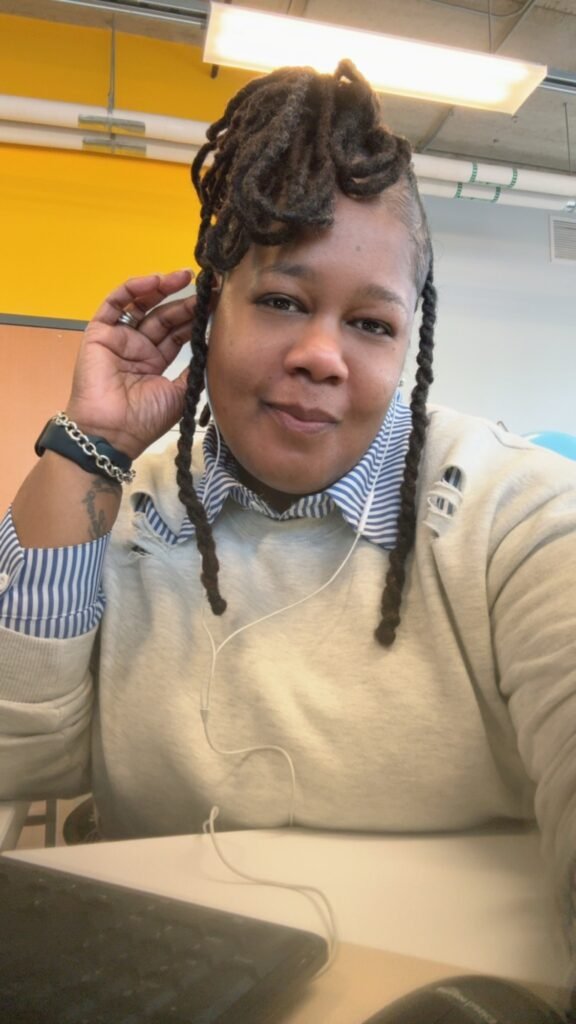
I met with Cierra Gross over Zoom, sitting in a cold conference room at work, wrapped in my sweater and wondering how I was going to make it through the rest of the day. But those thirty minutes—learning about her WrkReceipts app, her journey through workplace trauma, and how she turned pain into purpose—were sheer Black joy. The kind of joy that reminds you why we keep showing up to lead even when the ceiling above us feels more like concrete than glass.
Shared Struggles, Different Sectors
Cierra’s story of navigating racism and retaliation in corporate HR mirrored what so many Black women face in the nonprofit world—spaces built on justice but often starved of it internally. Like many of us leading missions for change, she confronted the contradiction of being needed but not nurtured.
Her words landed deeply with me:
“Like many of our customers, I experienced workplace trauma that showed me the depths of the human brain and how dark it can get… The only reason I survived that situation and forced an outcome that worked for me is that I am a subject matter expert in HR. I understand the rules and hold companies accountable for breaking them, but most employees don’t.”
For those of us leading nonprofits, that line hits home. We, too, often know the rules—grant requirements, compliance standards, DEI frameworks—but find ourselves navigating cultures that don’t live up to their own values.
And yet, we survive. We innovate. We build. Because survival for Black women has always been the first stage of systems design.
From Corporate Trauma to Collective Liberation
Cierra could have walked away. Instead, she built what she wished existed: Caged Bird HR, a company that gives employees independent HR support, and later WrkReceipts, an AI-powered platform with an employee advocate named Jayla. Her work exposes what happens when accountability becomes a product, not a privilege.
“Our flagship brand, Caged Bird HR, was the first puzzle piece in making the world of work more transparent and equitable for all. Our AI tech product, WrkReceipts, and its AI-powered employee advocate, Jayla, completes it… and the rest is a Legacy.”
For Black women in nonprofits, this innovation speaks volumes. We may not all code software, but we build infrastructures of care, accountability, and justice every day—with budgets smaller than some corporate marketing lines. Whether through community partnerships, wraparound services, or policy advocacy, our work is also about making the invisible visible—turning lived struggle into institutional change.
Breaking Concrete in Parallel Worlds
The concrete ceiling—that immovable, opaque barrier that limits the advancement of women of color—doesn’t just exist in corporate America. It’s alive in nonprofits that preach equity while protecting hierarchy, where Black women are celebrated for their “resilience” but rarely resourced for their leadership.
Cierra’s story gave me language for the work we’re already doing:
- Documenting the harm (naming inequity when it’s unsafe to shout it).
- Designing the fix (creating new systems of accountability).
- Distributing the truth (making the unseen measurable).
This is the work of leading beyond the concrete ceiling—whether through HR tech or housing programs, whether through AI or advocacy.
The Shared Blueprint: Lived Experience as Innovation
Cierra’s WrkReceipts transformed trauma into a tool. Nonprofit leaders do the same daily—we design healing circles after harm, create programs that meet needs others ignored, and form coalitions to hold the powerful accountable.
In both worlds, the lesson is the same: our lived experience is our research and development lab.
From WrkReceipts to Work Receipts
There’s a quiet symmetry between her tech and our testimony. We keep receipts too—impact reports, outcomes data, funding dashboards—all the tangible proof that Black women are running nonprofits with excellence despite structural inequity.
But the receipts also hold emotion, sacrifice, and faith. They tell the story of women holding communities together when systems fall apart.
Legacy as Resistance
When Cierra said, “The rest is a Legacy,” I thought about every Black woman executive director, program manager, and community builder I know. We’re all legacy-makers, chiseling our names into concrete walls. Her legacy in tech, and ours in nonprofit leadership, are not separate movements—they are echoes of the same revolution: turning survival into structure and trauma into transformation.
My Seven-Step Loop, Reimagined
From our conversation, I reframed my seven-step loop for leading beyond the concrete ceiling:
- Name the Pattern – Identify recurring inequities or systemic blocks.
- Design the Fix – Build new policies, practices, or partnerships.
- Document the Process – Make it teachable, trackable, transferable.
- Measure the Change – Combine data with stories of impact.
- Share the Learning – Tell it boldly. Visibility builds credibility.
- Secure the Infrastructure – Fund your systems like your mission depends on it (because it does).
- Regenerate the Leader – Protect your joy as part of the strategy.
Why These 30 Minutes Mattered
That conversation reminded me that leadership isn’t just about what we manage—it’s about what we model. Cierra’s journey through racism, resilience, and reinvention mirrors what countless Black women in nonprofits live daily. She used technology; we use trust. She built AI; we build alliances. Both are blueprints for liberation.
In the end, we are architects of equity—whether we lead from the boardroom or the block. And as long as we keep building, the concrete ceiling doesn’t stand a chance.